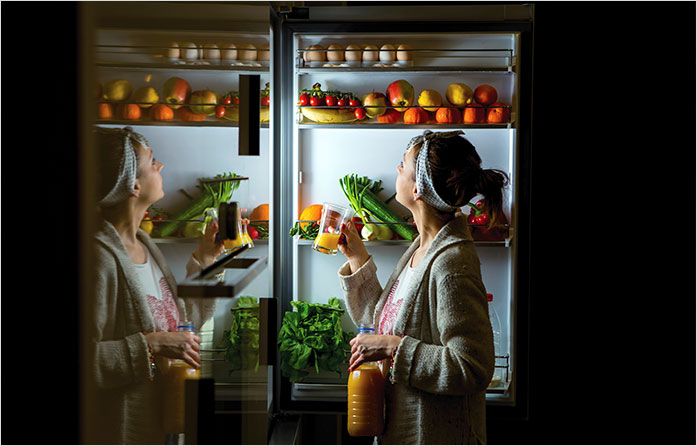
Night food is not a habit but a disease
Somehow, you can skip dinner and have no choice but to have a late night snack. However, if late-night snacks have become a habit like a daily routine, it is more like a disease. In fact, there is a disease called "night eating syndrome." Medically, late-night snacks are a type of eating disorder, such as bulimia or anorexia, and are not just habits that require correction for diet.
Seriously speaking, it could be a condition that must be treated for health. According to the diagnostic criteria, if you have no appetite in the morning, eat more than 25% of your daily calories for late-night snacks other than dinner, and have symptoms of sleep disorders or depression, you can suspect late-night snacks.
You gain more weight even if you eat the same food
Even if you eat
late-night snacks, the total calories you eat per day may not be high. However, even if you eat the same food, you gain more weight if you eat it at night. This is because our body moves toward consuming energy during the day, but tends to store energy in the evening. Insulin hormones store the remaining energy in fat cells, and glucagon is secreted during the day, so it is not stored in all fat cells, but only insulin is secreted at night, so even if you eat the same food, it accumulates more in fat cells. In addition, the body goes into a rest state at night, so when food comes in, it is quickly stored as fat to rest as much as possible. It means that the calories that work on the body are completely different from the pork belly that you grill in the morning and the pork belly that you grill with a late-night snack.
Then, can't we digest and go to late?
It takes about four hours to digest food. Then wouldn't it be okay to eat late night snack around 10 and go to sleep at 2? But let's think about it. How do you feel after staying up all night and sleeping at dawn for 7 hours? Still tired and sleepy. It doesn't matter how many hours you slept. The important thing is whether you took a rest when your body was in rest mode.
The same goes for a
meal. Instead of simply considering the time it takes to digest, it should be considered whether you ate at a time when hormones that act on the metabolic process work. Then, when is the time when the hormone related to eating is most active? It is active in the order of breakfast, lunch, and dinner, and studies show that it is safe for weight even if you eat before 7 p.m.
Biological clock is out of order
Even if I want to stop eating late at night, I can't because my biological clock is already broken. Hormones and autonomic nervous systems in our bodies are properly regulated and coordinated metabolic processes in accordance with the 24-hour cycle of the biological clock. At night, melatonin hormones induce sleep, and appetite suppressing hormones calm your appetite, allowing you to sleep well all night, and in the morning, your cortisol hormone levels are rapidly raised to cope with the stress you will receive during the day. At the same time, it secretes appetite-promoting hormones for energy supplementation.
So it's normal if you're not hungry until the next morning after dinner. If the sleep-awareness, eating-fasting cycle is working in perfect time. Not being able to stop eating late at night is not just a matter of will. You have to reset the biological clock that is off. That way, your appetite does not soar at night when you have to sleep.
This is all because of stress
Eating out of control is mostly due to mental problems. The cause of late-night snack syndrome is also estimated to be depression, anxiety, and stress. The problem is that if you relieve stress by eating late at night, you can become addicted. This is because the brain keeps stimulating the appetite center to make you feel good.
There is a question that can be simply distinguished between
emotional hunger caused by stress or really hungry. “I’m so hungry that you’re going to eat broccoli now?”‘ If it’s “yes,” it’s really hungry, and if it’s “no,” it’s emotional hunger.
Just realizing it’s
emotional hunger can subside your appetite. Not being stressed is not the solution. It’s impossible. So how can I lower my stress hormone levels?
Primitive humans went hunting and when confronted by a large animal, they had to desperately run away or confront it to survive. When this stress situation ends, the secretion of stress hormones also stops. This system works for modern people, too. Doing as much physical activity as possible is the most effective way to lower stress hormone levels. In other words, you have to exercise.
The best way is to fall asleep before 11pm
Sleep-inducing drugs can be more helpful than appetite suppressants for people who cannot stop eating late at night due to mental stress. That's how much sleep affects stress. Although there are individual differences, appetite-promoting hormones are usually secreted most actively around 11 p.m. and continue until about 1 a.m. Therefore, if you want to stop eating late-night snacks, it is important to go to bed before 11 p.m. Most say they can't sleep at that time.
Need a period to adjust to the new bedtime. You shouldn't watch TV or smartphone just because you can't sleep. Dr. Park Yong-woo, an obesity specialist, advises that sleeping is turning off the car, so if you can't turn it off, you shouldn't drive at least. If it still doesn't work, get up early. If you wake up early in the morning, you're bound to fall asleep. The best medicine for insomnia is 'not sleeping'.
TEST - Am I nocturnal?
□ The time I go to bed is irregular.
□ I can't fall asleep easily before 1 a.m.
□ I often fall asleep right after eating food.
□ Sometimes I wake up hungry.
□ Often instant food replaces meals.
□ I feel guilty when I eat a late night snack.
□ Binge eating when stressed or depressed.
□ Eat late-night snacks more than twice a week after dinner.
□ I often feel depressed.
□ I'm not very hungry at lunch even though I don't eat breakfast.
* If you have more than five, you're at risk for late-night snack syndrome
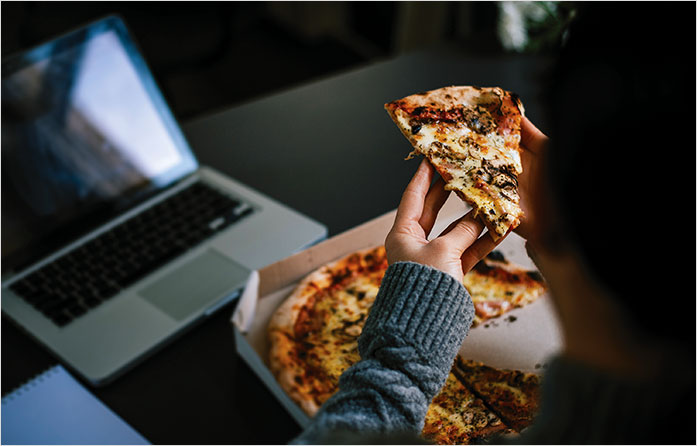
The biorhythm where
appetite control hormones work most effectively is when 14 hours of fasting (dinner to next breakfast) and 7 hours of deep sleep are observed.
Dinner delayed by an hour or two
To correct your lifestyle according to your biological clock, it is basic to eat three meals a day on time. <The author of the last diet ending in 12 weeks> and Professor Kang Jae-heon of Family Medicine at Seoul Paik Hospital say that the interval between meals should be 4 to 5 hours and should not exceed 6 hours. If the interval between meals seems to be too long, eat snacks in the middle or pull the next meal in advance.
For example, if you have to come home after 8 p.m. and have a meal, it's better to have a quick snack around 5 p.m. or grab a quick dinner near work on your way home from work. If you go to bed late, delaying dinner by one or two hours is also a way to avoid late-night snacks.
If you have to eat it, banana
instead of chickenThere is no way that you don't gain weight and feel good the next day even if you eat chicken, pigs' feet, or ramen for late-night snacks at 11 p.m. If you really want to eat it, eat a healthy late night snack that doesn't harm your condition the next day. Milk, banana, tofu, avocado, and chicken breast are appropriate for late-night snacks. When eaten, there is less irritation to the stomach, low calories, and high satiety. In particular, milk and bananas contain sleep-inducing ingredients.
Cucumber and carrot that can be chewed are also good choices. It is not bad to drink mixed grain powder or black bean powder in water. Although it is carbohydrate, it is digested well and raises blood sugar slowly. Even if it's a late night snack like this, you should finish it two hours before you go to sleep.
TIP. Late-night snack
Banana (Medium Size) 1 piece
Grape 38 grains
Orange/sweet tofu 1 piece
Black beans 2 tablespoons
Boiled eggs 1 to 2 pieces
Cheese 1.5 sheets
Milk 1 cup (200mL)
Plain yogurt 1 piece
Living habits for normalizing appetite hormones
♦ sunbathing during the day
Enough sun exposure during the day helps the biological clock work properly, helping to release appetite suppressing hormones at night.
♦ Take calcium, magnesium, and vitamin D supplements before going to bed
Eatingcalcium and magnesium together has a calming and relaxing effect, which helps induce sleep. Vitamin D also helps you sleep soundly. Studies show that a lack of vitamin D takes longer to fall asleep.
♦ No coffee after 2pm
Anyone who says that drinkingcoffee has no problem sleeping should already be considered a caffeine addiction. If you quit drinking coffee for a week, you can experience a qualitative change in sleep.
♦ Sleep for about 2 more hours on holiday
Even if the wake-up time and bed time change only once or twice, the biological clock starts to go wrong. In particular, wake-up time is important, so don't get up more than two hours late on weekends.
♦ Dark when sleeping, bright when waking up
If the lighting is darkened an hour before bedtime, melatonin secretion is smooth, making it easier to sleep. When the alarm goes off in the morning, you have to turn on the stand light to wake up quickly.
" late-night snackers have lost more than four teeth than those who haven't eaten late-night snacks."_ Denmark University of Copenhagen
"People with night eating syndrome have a higher degree of depression than those who do not."_ Journal of the Korean Obesity Society
"Women who ate before 9 p.m. and went to bed after at least 2 hours had a 23% lower risk of breast cancer than women who ate after 10 p.m. and went to bed after 1 hour."_ study of Spanish breast cancer patients
"For those who eat more than 25% of the total calories per day at night, the total intake was 1000 calories for men and 300 calories for women compared to those who did not."_ Journal of the Eastern Asian Society of Food and Living