Q. Many people are worried about nursing homes and nursing hospitals.
Since the
nursing hospital is literally a hospital, anyone in need of medical care can be admitted, but only those aged 65 or older or suffering from senile diseases such as dementia or stroke, among them, those with long-term care grades 1 and 2 (the lower the number, the worse).
It is true that the purpose of establishing
is treatment for hospitals and care for nursing homes, but the distinction is ambiguous. For example, many families want to take patients to nursing homes because of the low cost burden, but they often take them to relatively expensive hospitals because they are not rated. So, if you are in the hospital and your condition worsens, you will be given a new rating and taken to a nursing home.
It's a little weird, isn't it? If you're that sick, you'd better take him to a hospital, but he moved to a nursing home without a doctor just because it was cheap.
And vice versa. This is the case in which a healthy elderly person is taken to a hospital with the idea that "It seems like a bad son to take them to a nursing home?" or "The hospital where the doctor resides is still better."
In fact, according to a 2010 study by Professor Kwon Soon-man of the Graduate School of Health at Seoul National University, about 33% of patients admitted to nursing hospitals had no health problems, while 30% of those admitted to nursing homes needed medical treatment. The two institutions are health insurance and long-term care insurance, respectively, with different financial resources, different doctors' residence, and different purposes of admission themselves, which is a problem.
TIP. Take time to apply for ratings!
If symptoms appear in theelderly, most of them apply for a medical care grade judgment immediately, but in this case, there is a high probability of being rejected. This is because it is possible to make a reasonable judgment on whether long-term care is necessary or not only after sufficient treatment of symptoms and some rehabilitation. Therefore, it is recommended to apply for a rating with a deadline of at least three months after "work" such as cerebral infarction and fracture.
Q. Why is there such a difference in cost?
Both
nursing hospitals and nursing homes are subsidized by the government by about 80% and only about 20% return to their own expense, but there is a big difference in care costs. Nursing homes receive state funding, but nursing hospitals are 100% personal. Unlike nursing homes, which require one caregiver per 2.5 people, nursing hospitals do not have regulations that require caregivers to be mandatory.
Therefore, sometimes patients hire private caregivers, but because they are too expensive, hospitals usually ask for co-carers from outside companies to deploy them. Therefore, it is also important to see how many patients a caregiver takes care of when choosing a nursing hospital. In addition, 100% of the food expenses are covered by nursing homes and 50% by nursing hospitals.
Q. If you want to take me to a nursing home, what should I look for first?
You'll have to roughly pick your favorite candidate out of over 3,000 nursing homes nationwide. If you go to the National Health Insurance Corporation's website for long-term care insurance for the elderly, you can search variously depending on the conditions you want. Inquiries can be made according to desired standards by region, quota, and program, and since 2015, nursing homes across the country can be reviewed, evaluated as A to E grades, and the results can be disclosed and selected. It will be useful to choose a candidate site for a visit by disclosing details such as how the nursing home's workforce composition is, what non-payment items are, and what facilities are equipped.
Q. What are some things you must check when visiting a nursing home?
It is also important to know what the
admission fee or non-payment items are, but it is first to see the status of the inmates.
Elderly people's appearance is neat, they don't smell unpleasant, they're nutritionally healthy, etc. It is also important to pay attention to how many elderly caregivers are taking care of the elderly, how employees behave, and if they are well lit and ventilated, it is also important to see if related rehabilitation programs are in place if their parents have a stroke or dementia. It's also important to check the frequency of the program as well as the presence or absence of it.
Q.Nursing hospitals are also evaluated by dividing grades, right?
The
Health Insurance Review and Assessment Service evaluates and grades nursing hospitals according to about 40 nursing hospital adequacy evaluation items, giving benefits to the top hospitals and imposing sanctions on the bottom 20%. It is helpful to understand prior information like nursing homes because it discloses all the evaluation grades, but it is true that it is too much to see as an overall evaluation of the facility.
It evaluates the frequency of bedsores and the level of patients' daily performance, and even in the same nursing hospital, some hospitals are in serious condition, and some hospitals are difficult to see because their symptoms are light. In fact, nursing hospitals are divided into four main categories: complex treatment provision, rehabilitation treatment center, acute and severe patient center, and hospice patient center.
Just as there is an A-class hospital that uses only one floor of the
building as a hospital, and a B-class hospital with plenty of green space, it may or may not be a good hospital depending on what it is based on.
Q. What should I pay attention to when choosing a nursing hospital?
It is important to check how many patients a caregiver takes care of, whether they often change their position or bathe, whether there are blind spots due to the light, and whether there are specialized elderly nurses.
Sometimes there are guardians who only consult and die, and they have to stay for a long time, so you have to check the facilities carefully.
Q. What would you like to see improved nursing care?
I hope there is a clear distinction between the role of nursing homes that focus on the "life" of the elderly and nursing hospitals that provide "medical services."
If you are currently rated 1st or 2nd in long-term care, you are likely to be a hypertrophy patient with high risk of bedsores or severe dementia, and you will have to cut your bronchial tubes and wear a medical implant. It would be reasonable to take those people to the hospital.
Therefore, I hope that the system will be changed so that patients with grades 1 and 2 can benefit from nursing hospitals, and those with good conditions can benefit from nursing homes.
Q. Long-term care facilities, how will they change in the future?
Everyone wants to spend their old age in their original home, in a familiar village, and the system will gradually improve in that direction, but we still have no choice but to rely on facilities. The reality is that they lie in a multi-person room of more than seven people and rely on foreign caregivers who can't communicate well to leave their bodies to medical staff who work 24 to 48 hours continuously.
When I think of this extreme case, I'm somewhat convinced by the absurd prejudice of "I'll die soon if I go to the facility." Domestic nursing hospitals and nursing homes, which are considered relatively good examples, often have introduced Japan's advanced system, and typical ones are the elimination of falls, bedsores, odors, and physical restraint.
It is patient-friendly at a glance to choose an ondol room instead of a
bed to prevent falls and to let the patient crawl on his or her own to pee in the bathroom no matter how long it takes. In the future, I think the facilities should be changed for the dignity and convenience of patients. Any medical worker in the welfare of the elderly would dream of this, but the problem is the cost. Simply put, it takes a lot of “hand” to give patients autonomy, which will inevitably lead to labor costs. I wish the budget would be spent to provide practical help.
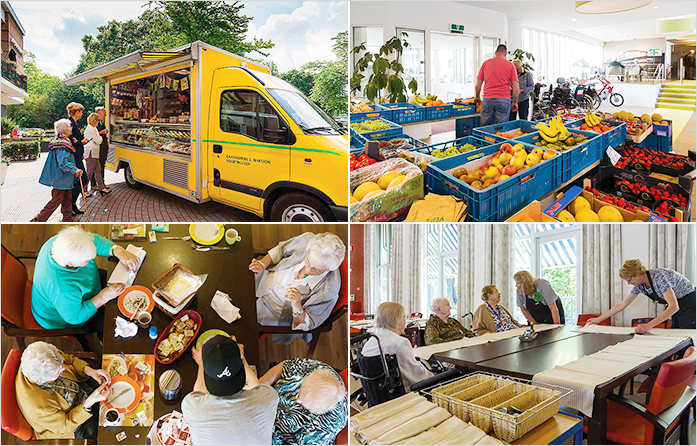 Humanitas in the Netherlands, considered a good example of a
 Q. Is there another good foreign system like the case in Japan?
There is a standard for selecting good nursing hospitals in the United States, and I envy you a lot when I see the list. It's more important whether the staff is kind, whether they call a patient grandfather or name, whether they can choose a roommate that suits their preference, or even whether the patient can smoke, than what the facility standards are like in Korea. When a secret agent secretly checks these items, it is bound to be an objective evaluation.
We also need to think about how Taiwan manages acute patients. An acquaintance went to a university hospital in Taiwan for training, and he connected the patients with rubber bands to the lead of a roll of tissue, and picked up a laundry tong They say that straightening is a rehabilitation treatment. "I thought it was so clumsy." It had its own meaning. At the hospital, the rate of return of acute patients from home is more than 80%, which means returning them to bed and recovering at home. Therefore, it is to teach real-life rehabilitation methods that can be practiced continuously at home.
Actual Taiwan has continued efforts since 2017 to drastically reduce acute hospital admissions for five symptoms: dementia, stroke, pathological fracture, heart failure, and cranial nerve damage. As a result, rehospitalization and mortality have decreased. If you are hospitalized, it is very different from Korea where you lie in the hospital until you die. Korea is also paying attention to the so-called "aging in place" in which I live in my home and village, and there are still many things that I need to have in order for that ideal to be realized. But I believe that one day will come.
Choose an ondol room instead of a bed to prevent falls, and let the patient crawl on his own to go to the bathroom no matter how long it takes, which is patient-friendly at a glance. In the future, I think the facilities should be changed for the dignity and convenience of individual patients."
PhotoShutterstock, Naver Drama <Shoot My Heart> Photo